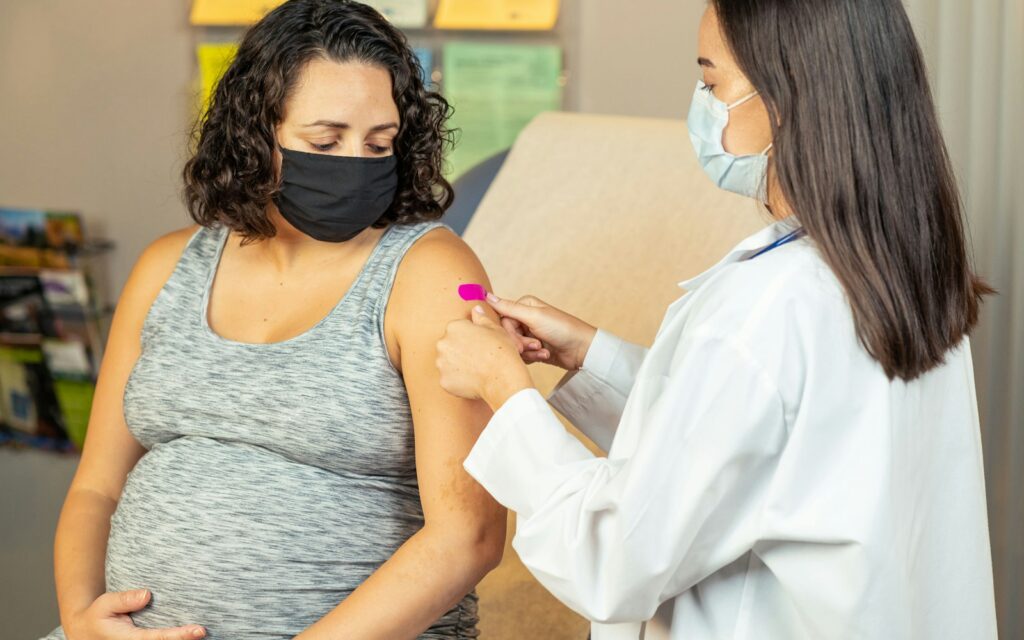
Two different strategies now protect infants from respiratory syncytial virus (RSV): maternal vaccination with Pfizer’s Abrysvo during pregnancy and direct infant immunization with the monoclonal antibody nirsevimab. Their pivotal phase 3 trials, MATISSE and MELODY, were both published in The New England Journal of Medicine, but they tested different products, populations, and endpoints, so their efficacy percentages should not be compared as if they came from a head-to-head trial.
Maternal vaccination and nirsevimab reach the infant through different biological routes
Abrysvo is an active vaccine given to the pregnant person. It presents the prefusion form of the RSV F protein to the immune system, prompting the mother to make antibodies that cross the placenta and protect the newborn after delivery. This is the same broad principle of active immunization that underlies other vaccine platforms, including those discussed in our explainer on how mRNA vaccines generate an immune response.
Nirsevimab works differently. It is a laboratory-made monoclonal antibody that binds the RSV F protein and blocks viral entry. The infant receives the antibody directly, so protection does not depend on the baby’s immune system first generating its own antibodies. Our FDA approval explainer on nirsevimab covers the mechanism and original approval in more detail.
This distinction is why nirsevimab is not an RSV vaccine. Monoclonal antibodies are also used therapeutically in diseases such as Alzheimer’s disease, as with lecanemab, but nirsevimab is unusual because it is given preventively to infants before RSV exposure.
The maternal vaccine showed strong protection against severe RSV illness in early infancy
In the MATISSE trial, 7,358 pregnant participants were randomized to receive a single 120 microgram dose of bivalent RSV prefusion F vaccine or placebo at 24 through 36 weeks’ gestation. At the prespecified interim analysis, 3,682 participants had received vaccine and 3,676 placebo, with 3,570 and 3,558 infants, respectively, included in the efficacy analysis.
Severe medically attended RSV-associated lower respiratory tract illness occurred within 90 days after birth in 6 infants in the vaccine group and 33 in the placebo group, corresponding to 81.8% vaccine efficacy (99.5% confidence interval, 40.6 to 96.3). By 180 days, there were 19 versus 62 cases, for 69.4% efficacy (97.58% confidence interval, 44.3 to 84.1).
The broader endpoint of medically attended RSV-associated lower respiratory tract illness did not meet its prespecified statistical success criterion at 90 days, despite a point estimate of 57.1% efficacy. That endpoint distinction matters: the strongest trial evidence was for preventing severe disease, not for eliminating every medically attended RSV infection.
Nirsevimab reduced medically attended RSV illness for about five months after one dose
MELODY randomized 1,490 healthy infants born at 35 weeks’ gestation or later in a 2:1 ratio to nirsevimab or placebo before RSV season. The primary endpoint was medically attended RSV-associated lower respiratory tract infection through 150 days after injection.
The primary endpoint occurred in 12 of 994 infants assigned to nirsevimab (1.2%) and 25 of 496 assigned to placebo (5.0%), corresponding to 74.5% efficacy (95% confidence interval, 49.6 to 87.1; P<0.001). RSV-associated hospitalization occurred in 6 infants in the nirsevimab group and 8 in the placebo group, an estimated efficacy of 62.1%, but that secondary comparison did not reach statistical significance in the original MELODY analysis (P=0.07).
Later pooled clinical-trial analyses and real-world studies strengthened the hospitalization evidence, and CDC now describes infant RSV antibodies as highly effective at preventing RSV-associated hospitalization. The practical takeaway is not that 74.5% can be compared directly with 81.8%. Those numbers refer to different outcomes measured in different trials.
CDC recommends one infant-protection strategy for most families
Current CDC guidance recommends Abrysvo at 32 0/7 through 36 6/7 weeks of pregnancy from September through January in most of the continental United States. Maternal antibodies then provide protection from birth through the infant’s first RSV season.
An infant RSV antibody is recommended for babies younger than 8 months who are born during or entering their first RSV season if the mother did not receive maternal RSV vaccine, the vaccination status is unknown, or the baby was born within 14 days of maternal vaccination. For babies born during October through March, CDC recommends giving an eligible infant antibody within the first week of life, ideally during the birth hospitalization.
CDC summarizes the policy simply: “Most infants will not need both.” Rare exceptions include infants whose mothers may not have mounted an adequate immune response, conditions that reduce transplacental antibody transfer, loss of maternal antibodies after procedures such as cardiopulmonary bypass, or unusually high risk for severe RSV disease.
Safety and timing create different tradeoffs for the two approaches
In MATISSE, overall adverse-event rates were similar between vaccine and placebo groups, but regulators paid close attention to a numerical imbalance in preterm birth. FDA labeling reports preterm birth in 5.7% of Abrysvo recipients and 4.7% of placebo recipients in the maternal program and states that available data are insufficient to establish or exclude a causal relationship. The U.S. indication is therefore limited to 32 through 36 weeks’ gestation.
Nirsevimab avoids maternal vaccination and provides protection directly to the infant. CDC states that side effects are usually mild, including pain, redness, or swelling at the injection site, while hypersensitivity reactions are uncommon. The main logistical issue is ensuring an eligible infant receives the dose at the right point in relation to RSV season.
What the evidence cannot yet answer
No randomized trial has directly assigned families to maternal Abrysvo versus infant nirsevimab and compared identical clinical endpoints. The two pivotal trials were conducted separately, with different eligibility criteria, intervention timing, follow-up structures, and outcome definitions. Trial efficacy percentages therefore cannot establish that one strategy is superior to the other.
MATISSE was funded by Pfizer. MELODY was funded by MedImmune/AstraZeneca and Sanofi, the developers of nirsevimab.
The choice also depends on circumstances that randomized efficacy estimates do not capture well, including expected delivery date, whether at least 14 days will pass between vaccination and birth, local RSV seasonality, maternal vaccine history, infant medical risk, and access to the products. In 2025, clesrovimab also became an infant antibody option for the first RSV season, so nirsevimab is no longer the only direct infant strategy.
The two strategies protect the same infant at different points in the care pathway
Maternal vaccination moves RSV prevention into prenatal care and gives the baby antibodies before birth. Nirsevimab moves the intervention to the newborn or infant and supplies those antibodies directly. Which route is preferable is therefore less a question of which efficacy percentage looks larger and more a question of which strategy can deliver reliable protection at the right time for that infant.
References
- Kampmann B, Madhi SA, Munjal I, et al. Bivalent Prefusion F Vaccine in Pregnancy to Prevent RSV Illness in Infants. N Engl J Med. 2023;388:1451-1464. DOI: 10.1056/NEJMoa2216480.
- Hammitt LL, Dagan R, Yuan Y, et al. Nirsevimab for Prevention of RSV in Healthy Late-Preterm and Term Infants. N Engl J Med. 2022;386:837-846. DOI: 10.1056/NEJMoa2110275.