A phase 3 trial published in The New England Journal of Medicine showed that circulating tumor DNA (ctDNA) can do more than track cancer: it can identify patients whose treatment should change. In IMvigor011, 250 patients with muscle-invasive bladder cancer and ctDNA-detected molecular residual disease after surgery were randomized to atezolizumab or placebo. ctDNA-guided treatment improved both disease-free and overall survival, showing that a blood-based molecular signal can be used to select patients for adjuvant therapy in a validated clinical setting.
Liquid biopsy looks for tumor DNA within a much larger pool of cell-free DNA
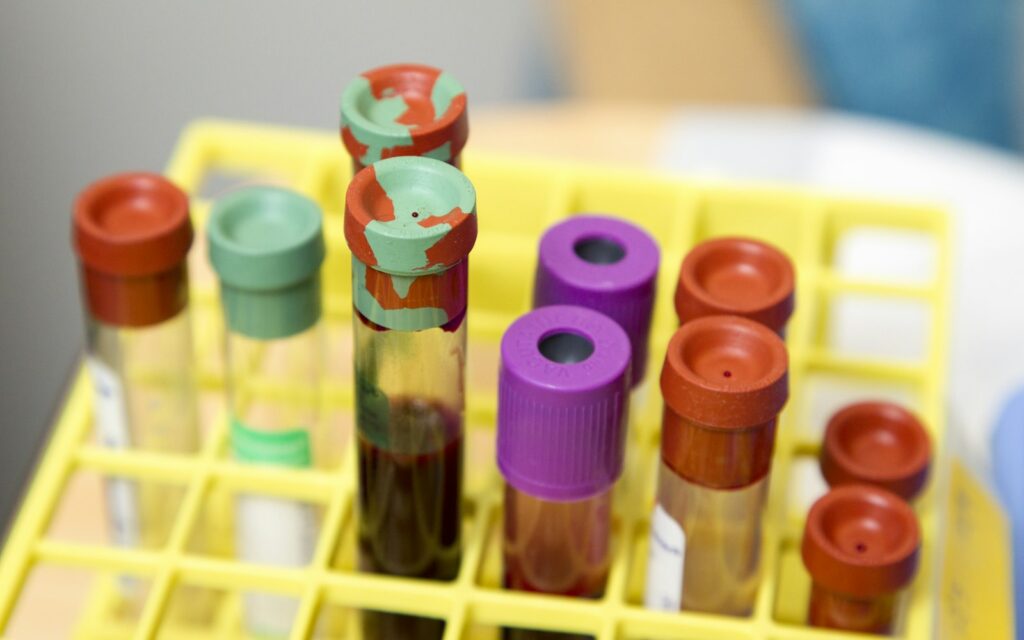
Cells throughout the body release short DNA fragments into the circulation. This background material is called cell-free DNA (cfDNA). A small fraction can come from cancer cells, and that tumor-derived fraction is called circulating tumor DNA.
A liquid biopsy analyzes a blood sample for these tumor-associated DNA fragments. Depending on the assay, it can search for single-nucleotide variants, insertions and deletions, copy-number changes, gene rearrangements, or a personalized set of mutations already identified in a patient’s tumor.
The distinction between cfDNA and ctDNA matters. Not every DNA variant found in plasma comes from cancer. Age-related clonal expansion of blood-forming cells can also release mutated DNA into circulation. In a 2019 Nature Medicine study that paired plasma sequencing with white-blood-cell sequencing, many plasma variants were attributable to clonal hematopoiesis rather than the tumor. Accurate interpretation therefore depends on assay design and clinical context.
Blood can sample tumor evolution in ways that a single tissue biopsy cannot
A conventional tissue biopsy provides important information about tumor architecture, pathology, and local molecular features, but it samples one physical location at one moment in time. Metastatic cancers can contain multiple genetically distinct subclones across different lesions.
ctDNA released from several tumor sites can enter the same bloodstream. That creates the possibility of detecting resistance mechanisms that are not present in the one lesion chosen for biopsy. This is especially relevant after treatment has applied selective pressure and the tumor has evolved.
That biology is already visible in breast cancer. Our ESR1 mutations explainer describes how acquired ESR1 mutations can emerge during aromatase-inhibitor therapy. In the SERENA-6 strategy, serial blood testing was used to identify emerging ESR1 mutations before standard imaging showed progression.
Early studies showed that ctDNA levels can track tumor burden over time
One of the landmark studies came from Dawson and colleagues in 2013. The investigators followed 30 women with metastatic breast cancer receiving systemic therapy and compared ctDNA with imaging, cancer antigen 15-3 (CA 15-3), and circulating tumor cells.
ctDNA was detected in 29 of 30 women (97%) in whom tumor-specific genomic alterations had been identified. By comparison, CA 15-3 was detected in 21 of 27 women (78%), and circulating tumor cells were detected in 26 of 30 women (87%). ctDNA also showed a wider dynamic range and tracked changes in tumor burden more closely than the other blood-based biomarkers.
That study was small and designed as proof of concept, not as evidence that treatment should be changed on the basis of ctDNA alone. Its importance was that it demonstrated how serial plasma measurements could reflect tumor dynamics during therapy.
Liquid biopsy can identify mutations that determine which targeted therapy is appropriate
Some blood-based assays are now FDA-authorized companion diagnostics. FoundationOne Liquid CDx, for example, analyzes cfDNA from plasma and can be used for specific approved biomarker-treatment combinations. FDA labeling also makes an important limitation explicit: a negative plasma result does not mean the tumor is negative for genomic findings, and tissue confirmation may be appropriate when feasible.
The practical use of a liquid biopsy therefore depends on the exact cancer, mutation, assay, and drug. Detecting a mutation is not automatically the same as finding an approved treatment.
Recent Bites of Bio examples show how this plays out clinically. Camizestrant is used in a ctDNA-defined ESR1-mutated breast cancer setting, while daraxonrasib targets RAS-mutated metastatic pancreatic cancer. In each case, molecular information matters because the treatment is linked to a defined tumor genotype.
ctDNA can also reveal molecular residual disease after apparently complete surgery
The most consequential recent advance is molecular residual disease (MRD). After a tumor has been surgically removed, imaging may show no visible cancer even though microscopic disease remains. A personalized ctDNA assay can sometimes detect tumor DNA during this radiographically silent period.
IMvigor011 tested whether that signal could be used to guide adjuvant treatment in muscle-invasive bladder cancer. The study enrolled 761 patients after cystectomy and used serial ctDNA testing. Among the 250 eligible patients who became ctDNA-positive, 167 were randomized to atezolizumab and 83 to placebo.
Median disease-free survival was 9.9 months with atezolizumab versus 4.8 months with placebo, with a hazard ratio of 0.64 (95% confidence interval, 0.47 to 0.87). Median overall survival was 32.8 versus 21.1 months, with a hazard ratio of 0.59 (95% confidence interval, 0.39 to 0.90).
The investigators concluded that “ctDNA-guided adjuvant therapy with atezolizumab led to significantly longer disease-free survival and overall survival than placebo.” The trial was funded by F. Hoffmann-La Roche. In May 2026, FDA approved atezolizumab for adults with muscle-invasive bladder cancer after cystectomy who have ctDNA MRD identified by an FDA-authorized test.
A negative ctDNA result can be reassuring without being definitive
One of the most important limitations of liquid biopsy is biology rather than sequencing technology. Tumors differ in how much DNA they release into blood. Small-volume disease, some tumor locations, and certain cancer types can produce very low ctDNA concentrations.
This creates false-negative risk. FDA’s FoundationOne Liquid CDx documentation specifically warns that a negative plasma result does not assure that the tumor lacks a genomic alteration. In some settings, a negative liquid biopsy should therefore trigger tissue testing rather than close the diagnostic question.
Assay sensitivity also depends on what the test is designed to detect. A broad tumor-profiling panel and a personalized MRD assay are not interchangeable. One searches across many genes for actionable alterations; the other may track a patient-specific mutation signature at very low abundance.
What the evidence cannot yet answer
ctDNA is not one universal test, and evidence from one cancer cannot automatically be transferred to another. A blood-based assay that guides treatment in bladder cancer may not have validated clinical utility in early breast, lung, colorectal, or pancreatic cancer.
It is also important to separate analytical validity from clinical utility. A test may detect tumor DNA accurately without evidence that acting on the result improves survival or quality of life. The strongest evidence comes from prospective trials that use ctDNA to make a treatment decision and then measure patient outcomes.
For now, liquid biopsy is best understood as a set of molecular tools rather than a replacement for tissue biopsy. It can complement pathology, reveal tumor evolution, identify actionable mutations, and detect residual disease, but its value depends on the clinical question being asked and whether the assay has been validated for that use.
References
- Dawson SJ, Tsui DWY, Murtaza M, et al. Analysis of Circulating Tumor DNA to Monitor Metastatic Breast Cancer. N Engl J Med. 2013;368:1199-1209. DOI: 10.1056/NEJMoa1213261.
- Powles T, et al. ctDNA-Guided Adjuvant Atezolizumab in Muscle-Invasive Bladder Cancer. N Engl J Med. 2025;393:2395-2408. DOI: 10.1056/NEJMoa2511885.