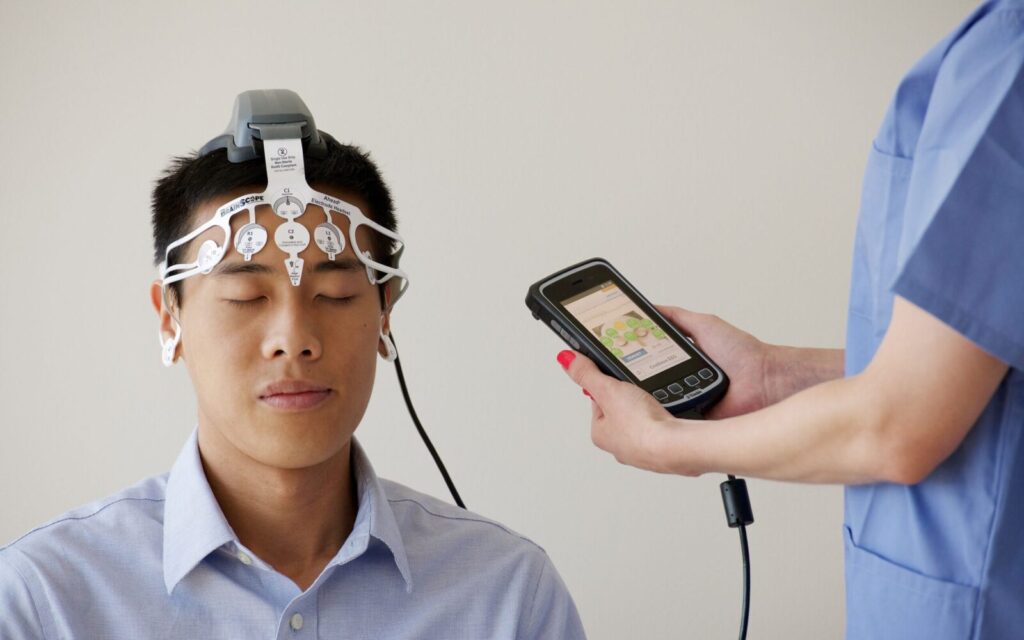
Patients undergoing inpatient epilepsy monitoring helped an artificial intelligence system reduce seizure false alarms by about 80% by correcting the system in real time through a smartphone app, according to a study published in Nature Medicine. The proof-of-concept platform combined EEG monitoring, automated seizure detection and a moderated large language model interface that let patients ask questions about their own data and provide feedback that was then used to retrain the detector.
The system let patients talk to their own epilepsy monitor
The study tested a platform designed to make epilepsy monitoring more interactive.
Patients were undergoing standard inpatient video-EEG monitoring at the University of Pennsylvania. Eleven participants had scalp EEG and two had intracranial EEG.
The researchers connected those physiological data streams to a secure smartphone interface powered by a moderated large language model. Patients could ask questions about their EEG-related data, receive alerts and summaries, report symptoms and respond to seizure notifications.
The system also incorporated information about sleep, medications, cognition and estimated seizure probability.
The goal was not simply to create a chatbot. The key idea was to make the patient part of a feedback loop so that the monitoring system could learn from the person wearing it.
False alarms are a major problem in automated seizure detection
Automated seizure detectors can help identify events in long EEG recordings, but they often generate false alarms.
That matters because an algorithm that alerts too often can become burdensome for patients and clinicians, reduce trust in the system and limit its usefulness outside highly supervised settings.
In this study, the baseline detectors had a median event-level sensitivity of 0.83 across 11 patients, but the median false-alarm rate was 0.47 per hour across 13 participants.
The researchers therefore tested whether patient feedback could be used as a source of rapid, real-world correction.
Patients provided feedback through the smartphone app
The app could notify patients when the system detected a possible seizure. Patients could then respond by confirming or rejecting the event.
Those responses were treated as weak labels, meaning they were useful for retraining the detector even though they were not assumed to be as precise as expert EEG annotations.
The system updated its seizure detector at predefined intervals when enough feedback was available.
This created a form of adaptive monitoring in which the model could improve during the same hospital stay rather than waiting for a later offline review.
Patient feedback reduced false alarms by about 80%
In the researchers’ pseudoprospective simulation, fine-tuning the seizure detector with patient annotations reduced false alarms by 80.9% compared with baseline.
Across the epilepsy monitoring unit stay, the median false-alarm rate fell from 0.736 per hour to 0.104 per hour, an 80.0% reduction.
The F1 score, which balances precision and sensitivity, also improved substantially.
Importantly, the researchers reported that the system preserved baseline sensitivity while reducing the number of false alerts.
That distinction matters. A detector could trivially reduce false alarms by becoming less willing to call anything a seizure, but that would be clinically useless if it missed true events.
The study involved only a subset of patients in the feedback analysis
Although 13 patients participated in the overall platform study, the prospective seizure-annotation feature was unavailable for the first two participants.
Among the remaining 11 patients, clinicians confirmed 59 seizures. The system generated 58 alerts, and six patients provided annotations that confirmed or rejected events through the platform.
The raw seizure alerts themselves performed poorly before retraining, with low sensitivity and precision. The value of the experiment was therefore not that the initial alerts were highly accurate, but that patient feedback could rapidly improve the detector.
Patient-confirmed annotations were often reliable
For events that patients explicitly confirmed, the annotations were relatively accurate in this small dataset.
The paper reported a sensitivity of 1.0 for the five confirmed seizures included in that analysis, a precision of 0.71 and a negative predictive value of 1.0 for rejected events.
Those numbers should be interpreted cautiously because the sample was very small.
Still, they support the central premise that patients can contribute clinically useful information during monitoring rather than acting only as passive recipients of device output.
The conversational AI was broader than the seizure detector
The platform had two distinct AI components that are easy to conflate.
One component was the seizure-detection model that analyzed EEG data. The other was a moderated large language model interface that allowed patients to ask questions and receive explanations about their data.
The language model itself was not the seizure detector.
Instead, it served as the communication layer connecting the patient to the monitoring system.
This distinction is important because the study is not evidence that a general-purpose chatbot can diagnose seizures from conversation.
Patients also used the system to understand their own data
The interface could answer questions about sleep, medication timing, EEG trends and seizure probability using information available from the monitoring system.
Response times were generally fast in the inpatient setting, with conversational interactions taking about two seconds and more complex queries that combined plots and other data taking about nine seconds.
Five of the 13 participants spontaneously asked whether they could continue using the system after discharge.
That finding is qualitative rather than proof of clinical benefit, but it suggests that at least some patients found the interface useful enough to want ongoing access.
A clinician-in-the-loop version performed even better
The researchers also simulated a version in which the system could ask an expert to review uncertain predictions.
With clinician feedback added, the false-alarm rate fell by 82.6%, from a median of 0.210 per hour to 0.044 per hour.
The F1 score improved by 271.5% in that simulation.
This suggests that the most practical future system may not be fully autonomous. Instead, patient feedback could handle many routine corrections while experts are reserved for uncertain or high-stakes cases.
The study does not show that the system is ready for home use
The biggest limitation is the setting.
All 13 participants were hospitalized in an epilepsy monitoring unit, where EEG quality is high, clinical staff are nearby and seizures are being observed under controlled conditions.
Home monitoring is much messier. Sensors may move, patients may sleep in different positions, internet connectivity may vary and many seizure-like events may be harder to classify without video or clinician review.
The study therefore does not establish that the same 80% reduction in false alarms would occur in outpatient wearables or home EEG systems.
The sample was very small
Thirteen participants is enough for a proof-of-concept study, but far too small to define how well the platform would work across the broader epilepsy population.
Epilepsy includes many seizure types, EEG patterns, medications and comorbidities. A detector that adapts well for one patient may behave differently in another.
The feedback analysis was smaller still because only six patients provided prospective seizure annotations through the platform.
Larger studies will be needed to determine how much patient feedback is required and whether the improvement persists over weeks or months.
The study measured detector performance, not seizure control
Another important distinction is what the trial actually tested.
The researchers measured whether patient-device interaction could improve automated detection and communication.
They did not test whether the platform reduced seizure frequency, prevented injuries, improved medication adherence or reduced emergency visits.
Those outcomes would require larger and longer prospective trials.
Patient feedback could make medical AI more personalized
The broader concept may extend beyond epilepsy.
Many medical devices use algorithms that perform differently across individuals. A system that continuously incorporates patient feedback could adapt to the physiology and habits of the person using it.
The challenge is ensuring that those adaptations remain safe and do not drift in response to incorrect feedback.
The researchers addressed that risk partly through guardrails and by exploring a clinician-in-the-loop pathway for uncertain events.
The study fits a broader shift toward interactive neurotechnology
Neurology is increasingly moving toward systems that do more than record data.
Bites of Bio recently covered an optogenetic therapy that uses specialized visual hardware to deliver information to the nervous system, as well as a study mapping a specific brain circuit linked to compulsive behavior. Both reflect the same broader trend: researchers are trying to interact with neural systems more precisely rather than simply observe them.
The epilepsy platform adds another layer by making the patient an active participant in that interaction.
The strongest finding is the feedback loop, not the chatbot
The headline result is easy to frame as another AI-in-medicine story, but the more interesting part is the feedback architecture.
The system allowed patients to correct an automated detector during real clinical monitoring, and those corrections materially improved performance.
That is different from deploying a fixed model and asking patients to trust it.
If larger studies confirm the approach, the future of seizure monitoring may involve devices that learn continuously from the people they are monitoring.
Funding and study context
The work was funded in part by the U.S. National Institutes of Health. The NIH described the platform as a proof of concept for two-way communication between patients and medical monitoring systems.
The authors emphasize that the system remains a research prototype and that clinical seizure concerns during the study were still directed to the patient’s care team.
References
- Goldblum Z, Shi H, Xu Z, et al. Human-artificial intelligence collaboration for comanaging epilepsy in real time. Nature Medicine. 2026. DOI: 10.1038/s41591-026-04680-4.
- National Institutes of Health. Patients engage with epilepsy monitor in real time, improving seizure detection. October 13, 2026. NIH research summary.