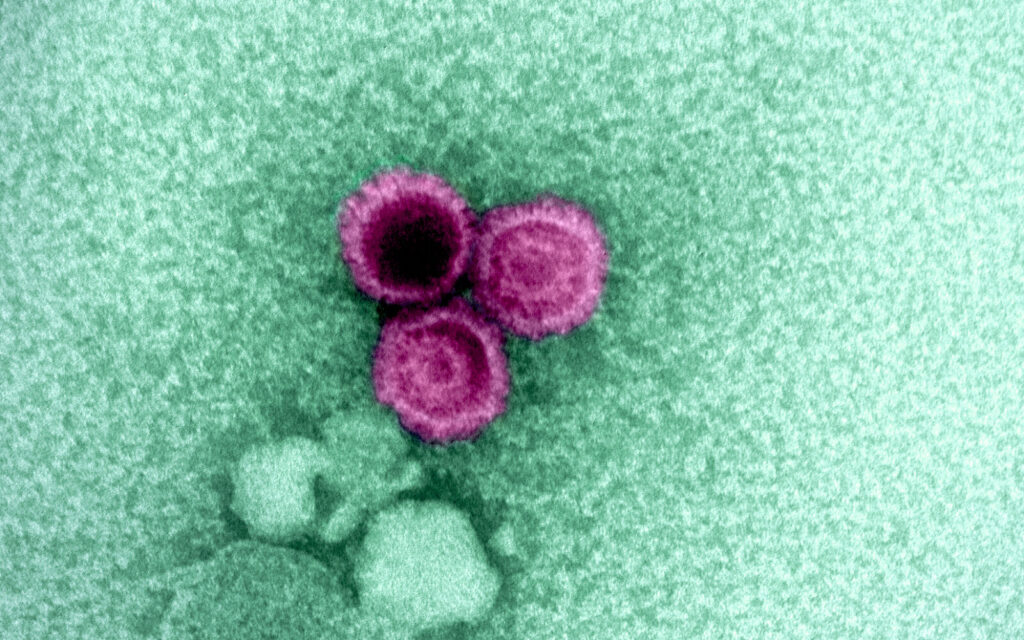
Epstein-Barr virus activity increased in the months before multiple sclerosis relapses in a longitudinal study published in Nature Medicine, raising the possibility that episodic viral reactivation helps prime the immune system for an attack. The study found coordinated changes in B cells and monocytes up to three months before relapse, including higher levels of the EBV transcript LMP-1 and an increase in B cells carrying the viral surface protein gp350.
EBV is already strongly linked to the development of multiple sclerosis
Epstein-Barr virus, or EBV, is one of the most common human viruses. It usually infects people during childhood or adolescence and then remains in the body for life, primarily inside B cells.
EBV has emerged as one of the strongest environmental risk factors for multiple sclerosis. Large epidemiologic studies have shown that EBV infection typically precedes MS onset, and the risk of developing MS rises sharply after infection.
Bites of Bio previously covered the broader evidence linking Epstein-Barr virus with lupus and multiple sclerosis. What has been less clear is whether EBV also contributes to the timing of relapses after MS has already developed.
The new study addresses that second question.
The researchers built a time-resolved picture of the immune system before relapse
The investigators used samples from the long-running Comprehensive Longitudinal Investigation in MS at Brigham and Women’s Hospital, known as CLIMB.
Because patients in CLIMB undergo regular clinical visits, MRI scans and blood collection, the researchers could retrospectively identify rare blood samples that had been drawn while a patient was clinically stable but then happened to fall within the months before a confirmed relapse.
In total, 135 participants contributed samples across the study’s assays: 114 people with MS and 21 healthy controls. Fifteen people with MS were included in the initial single-cell discovery analysis, while additional patients were evaluated using bulk RNA sequencing, flow cytometry and targeted viral transcript testing.
Relapses were independently confirmed by two neurologists and required a contrast-enhancing lesion on MRI. That strengthened the study’s ability to distinguish true inflammatory relapse from fluctuations in symptoms.
Immune changes appeared up to three months before symptoms
The researchers identified a reproducible pre-relapse immune signature that appeared as early as 90 days before clinical onset.
The most prominent changes involved monocytes and several B cell populations. Many of the genes that became more active before relapse were part of antiviral and interferon-related programs, suggesting that the immune system was responding to a viral stimulus before the neurologic attack became apparent.
In B cells, viral mRNA translation was the most strongly enriched pathway in the pre-relapse state. The researchers also found that some of the altered B cell transcriptional programs overlapped with known genetic risk loci for MS.
That overlap is important because it suggests that viral activity and inherited susceptibility may converge on the same immune pathways rather than acting independently.
Atypical B cells expanded before relapse
A major focus of the study was a population of CD11c-positive atypical B cells. Similar cells have been reported in autoimmune disease and chronic viral infection and are capable of strong antigen presentation and inflammatory signaling.
In a validation analysis of 23 patients with paired remission and pre-relapse samples, 21 of the 23 showed an increase in these atypical B cells before relapse. The median increase was 1.6-fold.
The finding is notable because B cells are already central to MS biology. Therapies that deplete B cells can sharply reduce relapse rates, which is one reason researchers have been trying to understand what B cells are doing immediately before an attack.
The new data suggest that a specific activated B cell state may emerge during that window.
EBV proteins and transcripts were also higher before relapse
The team then looked directly for evidence of EBV activity.
Using flow cytometry, they measured the EBV surface protein gp350 on B cells. The model-predicted frequency of gp350-positive B cells increased from 0.186% during remission to 0.263% before relapse.
Although those percentages are small, the increase was statistically significant. The odds of detecting gp350-positive B cells were about 41% higher in the pre-relapse state, with the strongest signal in the 0-to-90-day window before relapse.
Separately, the researchers measured EBV transcripts in sorted B cells from paired samples. Among the viral genes tested, LMP-1 was significantly elevated before relapse.
LMP-1 is an EBV protein that can alter B cell survival and inflammatory signaling. Most of the other viral genes tested trended in the same direction, but not all reached statistical significance.
The pattern may reflect abortive rather than full viral reactivation
An important nuance is that the findings do not necessarily indicate widespread production of new infectious virus particles.
The pattern was more consistent with what researchers call abortive EBV reactivation. In that state, latently infected B cells switch on some viral genes and inflammatory programs without necessarily completing the entire viral replication cycle.
That could still matter biologically. Even a small population of reactivating B cells may influence nearby immune cells through cytokines, interferons and antigen presentation.
The study found that monocytes, which are not a typical reservoir for EBV, also showed strong interferon-related activation before relapse. The authors argue that this could reflect downstream signaling from virally activated B cells.
MS risk genes and EBV-responsive programs converged in the same cells
The researchers also compared the pre-relapse B cell programs with genetic variants known to increase MS susceptibility.
Several of the most altered B cell states were enriched both for MS risk genes and for regulatory regions bound by EBNA-2, an Epstein-Barr virus protein known to reshape host gene expression.
This led the authors to propose a two-part model: a transient trigger such as EBV reactivation occurs in someone whose immune system is genetically primed to respond strongly, and the combined effect pushes the immune system toward the inflammatory threshold required for relapse.
That model remains a hypothesis, but it provides a mechanistic framework linking viral biology with inherited MS risk.
The findings do not prove that EBV causes each relapse
The most important limitation is the observational design.
The study shows that EBV-associated activity preceded relapse, but temporal association alone cannot prove causation. Another immune disturbance could potentially reactivate EBV while independently contributing to relapse.
The number of people contributing to each molecular analysis was also modest because true pre-relapse samples are difficult to obtain. The single-cell discovery cohort included only 15 people with MS, although the findings were tested using several additional cohorts and methods.
The researchers also studied blood, not the brain or spinal cord. They explicitly note that it remains unknown how the peripheral immune changes they observed connect to formation of new lesions in the central nervous system.
The signal is not ready to predict relapses in the clinic
The study raises the possibility that viral transcripts, atypical B cells or gp350-positive B cells could one day contribute to a blood test that identifies an approaching MS relapse.
That is not clinically available now.
The effect sizes were modest, and the researchers did not establish sensitivity, specificity or a validated cutoff that could reliably distinguish patients about to relapse from those who will remain stable.
Prospective studies would need to collect samples at predefined intervals and test whether the signature can predict relapses before symptoms or MRI changes occur.
The study adds a new layer to the EBV-MS story
Previous research has established a strong relationship between EBV infection and the risk of developing MS. This study suggests that the virus may remain relevant after disease onset by periodically reshaping the immune environment before relapses.
That does not mean every relapse is caused by EBV, or that antiviral treatment would necessarily prevent attacks.
But if the finding is replicated, it could help explain why B cells are such powerful drivers of MS activity and why B cell-directed therapies are so effective.
It also provides a different perspective from experimental approaches aimed at repairing damage after it occurs. Bites of Bio recently covered an experimental MS drug that reversed paralysis and vision loss in mice. The EBV study instead asks what may happen before an inflammatory attack begins.
The next question is whether blocking reactivation changes relapse risk
The strongest test of the hypothesis would be interventional.
If future studies can safely suppress EBV reactivation and show that doing so reduces relapses, the causal case would become much stronger. Researchers could also investigate whether existing B cell-depleting therapies work partly because they remove the cellular reservoir in which EBV persists.
For now, the new findings should be viewed as evidence of a pre-relapse viral and immune signature, not as proof of a new treatment target.
Funding and disclosures
The study was supported by the U.S. Department of Defense, the Water Cove Charitable Foundation, the Cindy Larsen-Chugg Chair, a Broad Institute Founders Grant and philanthropic support. The authors state that the funders had no role in study design, analysis or publication decisions.
Senior author Tanuja Chitnis reported research support and consulting or advisory relationships with several biotechnology and pharmaceutical companies, including Genentech, Novartis, Octave Biosciences and Sanofi. Howard Weiner reported research support and advisory relationships disclosed in the paper.
References
- King DA, Saxena S, Caefer D, et al. EBV reactivation priming of the peripheral immune system in multiple sclerosis relapse. Nature Medicine. 2026. DOI: 10.1038/s41591-026-04665-3.
- Kiani L. EBV reactivation precedes multiple sclerosis relapse. Nature Reviews Neurology. October 9, 2026. DOI: 10.1038/s41582-026-01280-1.
- Mass General Brigham. Study details how Epstein-Barr virus reactivation may lead to MS relapses. October 6, 2026. Research summary.