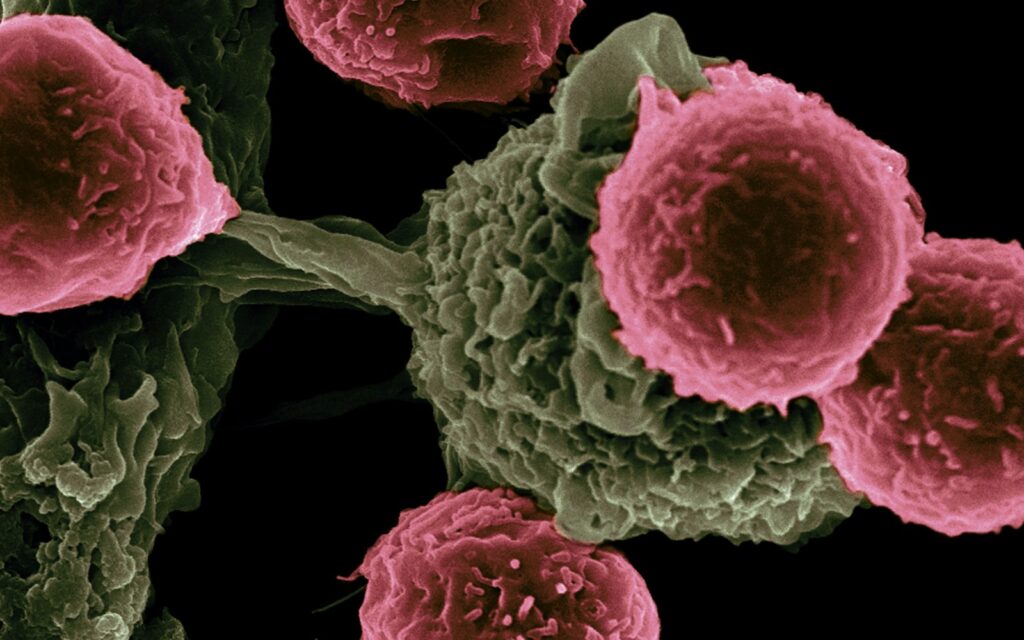
KRAS mutations drive more than 90% of pancreatic ductal adenocarcinomas (PDAC), yet the protein resisted direct drug development for decades because its surface offered few stable pockets for small molecules and because the mutant protein cycles between active and inactive conformations. That biology is now clinically relevant: a phase 3 trial published in The New England Journal of Medicine in 2026 showed that the RAS(ON) inhibitor daraxonrasib prolonged survival compared with chemotherapy in previously treated metastatic pancreatic cancer, helping turn a historically difficult target into an actionable one.
KRAS acts as a molecular switch that controls cell-growth signaling
KRAS encodes a small GTPase, a protein that alternates between an inactive GDP-bound state and an active GTP-bound state. In normal cells, growth-factor signals briefly shift KRAS into the GTP-bound state, allowing it to relay signals through pathways such as RAF-MEK-ERK and PI3K-AKT. GTP hydrolysis then returns the protein to its inactive state.
Oncogenic KRAS mutations interfere with that shutoff step. The result is persistent signaling that promotes proliferation, survival, altered metabolism, and changes in the tumor microenvironment. In pancreatic cancer, KRAS mutations arise early during tumor development and are commonly accompanied later by alterations in genes such as TP53, CDKN2A, and SMAD4.
The mutation pattern also matters. Across large pancreatic cancer cohorts, KRAS G12D accounts for roughly 40% to 47% of cases, G12V for about 30% to 35%, and G12R for about 15% to 17%. KRAS G12C, the mutation that first became directly druggable in lung cancer, is uncommon in pancreatic cancer at roughly 1% to 2%. That distribution is one reason the first generation of G12C-specific drugs could not address most pancreatic tumors.
KRAS was difficult to drug because the protein offers few stable binding pockets
Traditional small-molecule drugs often work by fitting into a well-defined pocket on a target protein. KRAS presented a different problem. Its surface is relatively smooth, and its natural nucleotide-binding site grips GDP and GTP with very high affinity. Competing directly with those nucleotides was therefore impractical.
The first major breakthrough came from identifying a transient pocket beneath the switch II region of KRAS G12C. Covalent inhibitors could bind the cysteine created by that specific mutation and trap the protein in its inactive state. That strategy validated KRAS as a direct drug target, but it was mutation-specific. G12D, G12V, and G12R do not contain the same reactive cysteine, so they required different chemistry.
This distinction is especially important in pancreatic cancer because its most common KRAS mutations are not G12C. The challenge became broader: researchers needed compounds capable of reaching multiple mutant forms or targeting a shared functional state of RAS rather than one amino-acid substitution.
Newer drugs target the active RAS state rather than one rare mutation
Daraxonrasib takes a different approach. It is an oral RAS(ON) multiselective inhibitor designed to bind the active, GTP-bound state of mutant and wild-type RAS proteins. Instead of depending on the G12C cysteine, it targets a broader set of RAS-driven tumors.
That mechanism is closely related to the recent FDA approval of Rasonque (daraxonrasib). On August 26, 2026, the FDA approved the drug for adults with metastatic pancreatic adenocarcinoma who have received at least one prior systemic therapy or who are not candidates for multiagent systemic therapy. The approved indication is not restricted to a single KRAS mutation.
The shift from mutation-specific inhibition toward multiselective RAS inhibition reflects a larger trend in molecular profiling and precision oncology: the therapeutic question is increasingly not just whether a tumor carries a mutation, but which conformational state, signaling dependency, and resistance pathway can be exploited.
A phase 3 trial showed a survival benefit over chemotherapy
The RASolute 302 trial randomly assigned 500 patients with previously treated metastatic pancreatic ductal adenocarcinoma to daraxonrasib or physician’s-choice chemotherapy. Of the participants, 91.8% had RAS G12 mutations. The dual primary endpoints were overall survival and progression-free survival in the RAS G12 population.
Median overall survival was 13.2 months with daraxonrasib versus 6.6 months with chemotherapy in the RAS G12 population, corresponding to a hazard ratio of 0.40 (P<0.001). Median progression-free survival was 7.3 months versus 3.5 months, with a hazard ratio of 0.45 (P<0.001).
The results were similar in the overall trial population, which also included patients with RAS G13 or Q61 alterations or no identified RAS mutation. Median overall survival was 13.2 months with daraxonrasib versus 6.7 months with chemotherapy, and median progression-free survival was 7.2 months versus 3.6 months.
Grade 3 or higher adverse events occurred in 61.8% of patients receiving daraxonrasib and 69.6% receiving chemotherapy. Treatment-related adverse events led to discontinuation in 1.2% versus 11.2%, respectively. Rash, diarrhea, stomatitis, nausea, and vomiting were among the common toxicities associated with daraxonrasib.
The new drugs do not make KRAS biology simple
Direct RAS inhibition has solved one problem, but it has not eliminated resistance. Tumor cells can reactivate signaling through upstream receptor pathways, alter nucleotide cycling, amplify RAS signaling, or engage parallel survival pathways. Different KRAS alleles can also behave differently, which means results from one mutation cannot automatically be generalized to another.
KRAS G12R is a useful example. It is relatively common in pancreatic cancer but biologically distinct from G12D and G12V, with differences in downstream signaling and drug sensitivity. That heterogeneity helps explain why the field is moving toward combinations and broader RAS-pathway strategies rather than treating every KRAS mutation as interchangeable.
The same principle appears in other molecularly defined cancers. For example, ESR1 mutations in breast cancer can change treatment response even within the same disease category. Genotype increasingly shapes which therapy is likely to work and which resistance mechanism is most relevant.
The evidence is strong for previously treated metastatic disease, but several questions remain
RASolute 302 was randomized and phase 3, which makes its survival results more informative than earlier single-arm studies. It was also open-label, and the trial was funded by Revolution Medicines, the manufacturer of daraxonrasib. The primary efficacy analysis was centered on patients with RAS G12 mutations, so the evidence is less certain for uncommon RAS alterations and for tumors without an identified RAS mutation.
The trial also addressed previously treated metastatic disease. It does not establish that daraxonrasib should replace first-line multiagent chemotherapy in patients who can tolerate it. Studies are evaluating RAS inhibition earlier in treatment and in combinations, but those questions require separate evidence.
Pancreatic cancer therefore remains difficult to treat, but the scientific problem has changed. KRAS is no longer considered inaccessible simply because it lacks an obvious drug-binding pocket. The current challenge is determining how broadly RAS inhibition works, how long responses can be sustained, and how best to prevent or overcome resistance.
References
- O’Reilly EM, Wainberg ZA, Hendifar AE, et al. Daraxonrasib or Chemotherapy in Previously Treated Metastatic Pancreatic Cancer. N Engl J Med. 2026;395:325-337. DOI: 10.1056/NEJMoa2605555.
- Chan LL, Kwong TT, Yau JCW, Chan SL. RAS-targeted therapies for pancreatic cancer. ESMO Gastrointest Oncol. 2026;13(Pt B):100414. DOI: 10.1016/j.esmogo.2026.100414.
- U.S. Food and Drug Administration. FDA Approves First in Class Targeted Therapy for Metastatic Pancreatic Cancer. August 26, 2026. FDA press release.