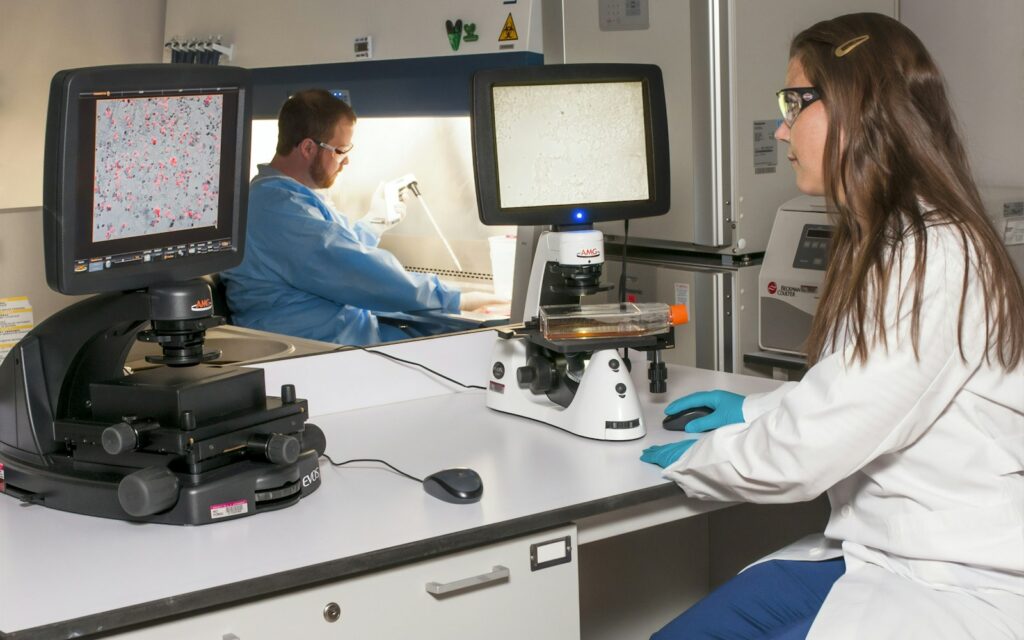
Single intestinal stem cells cultured with a defined combination of growth factors self-organize into three-dimensional structures that reproduce the crypt-villus architecture of the intestinal wall, a finding by Sato and colleagues in the laboratory of Hans Clevers published in Nature in 2009. That paper launched the modern organoid field. Sixteen years on, patient-derived organoids grown from a person’s own tumor cells have been shown by Vlachogiannis and colleagues in Science in 2018 to predict clinical response to cancer chemotherapy, and cerebral organoids grown from human pluripotent stem cells (Lancaster and Knoblich, Nature 2013) have become the standard human model for developmental brain disorders.
Organoids exploit a property of stem cells that was underestimated
What is an organoid
An organoid is a three-dimensional cluster of cells, typically a few hundred micrometers to a few millimeters across, that reproduces at small scale the architecture and cellular composition of a specific organ or tissue. The critical insight of the field is that stem cells, given the right molecular environment, will spontaneously self-organize into the correct three-dimensional structure without external instruction. Intestinal organoids form crypts and villi. Cerebral organoids form cortical layers. Kidney organoids form nephrons. Liver organoids produce bile acids. The information required to build the tissue is encoded in the stem cells themselves. The culture system provides only permissive conditions.
The 2009 Sato paper set the template
How the field began
Sato and colleagues at the Hubrecht Institute showed that a single Lgr5-positive intestinal stem cell, placed in a three-dimensional gel with the growth factors Wnt3a, R-spondin, EGF, and Noggin, could generate a full crypt-villus organoid containing all the differentiated cell types of the intestinal epithelium. On the paper’s release, Clevers described the finding by saying that “these Lgr5 stem cells demonstrate a remarkable drive to form normal gut epithelium, considering that our artificial culture system provides nothing but a few growth factors,” and suggested that “the application of adult stem cells in regenerative medicine may, in some cases, be simpler than we suspect.” The experimental template rapidly generalized. Within five years, groups had established organoids from stomach, pancreas, liver, prostate, lung, breast, and salivary gland tissue.
Brain organoids extended the reach to development
In parallel, Lancaster and Knoblich at the Institute of Molecular Biotechnology in Vienna reported in Nature in 2013 that human pluripotent stem cells could be induced to form cerebral organoids up to a few millimeters in diameter containing discrete brain regions with cortical layers and mature neuronal subtypes. Cerebral organoids grown from patients with microcephaly reproduced the disease phenotype. That result opened a way to study human brain development and disorders that could not previously be modeled in animals, where the human-specific features of cortical development are absent.
Patient-derived tumor organoids move toward the clinic
Where they’re being used: oncology
The clearest translational payoff so far is in oncology. Tumor cells taken from a patient by biopsy or surgery can be cultured as patient-derived organoids (PDOs) within a few weeks, retaining the genetic and morphological features of the original tumor. Vlachogiannis and colleagues, working with a cohort of patients with metastatic gastrointestinal cancers who had already been treated on clinical trials, grew PDOs from their tumors and tested response to the same drugs the patients received. The organoid response correlated with the clinical response with high accuracy: PDOs correctly predicted patients who would respond to treatment, and correctly identified those who would not, in the majority of cases.
A subsequent trial by Ooft and colleagues in Science Translational Medicine in 2019 showed the PDO test predicted response to irinotecan-based chemotherapy in more than 80% of patients with metastatic colorectal cancer without misclassifying any who would have benefited from treatment. Prospective validation trials are now running in colorectal, pancreatic, gastric, and other cancers.
The technology has limits and open ethical questions
Limits and open questions
Still, organoids are a large advance over two-dimensional cell culture but still an approximation of full organs. They lack a blood supply, which limits their size and, in the case of brain organoids, the maturity of the cells at the center of the tissue where nutrients cannot reach. They typically lack the immune, vascular, and stromal components of real tissue, though co-culture systems that add these compartments are an active area of development. And though patient-derived organoids capture much of a tumor’s biology, they cannot fully reproduce the tumor microenvironment or the systemic factors that shape drug response.
In addition, cerebral organoids raise questions the field is only starting to address. Recordings from mature brain organoids have detected electrical activity resembling that of early developing brain tissue. Whether this indicates any form of experience, and at what point (if any) an organoid deserves ethical protection, is being actively debated. Current organoids are small, disorganized relative to a real brain, and lack sensory input, and the mainstream scientific consensus is that they are not conscious, but the field is developing guidelines proactively rather than waiting for the question to become urgent.
What the evidence cannot yet answer
Finally, whether PDO-guided treatment selection improves patient outcomes in randomized trials, not just in retrospective correlations, is the current open question in the clinical translation. The costs and turnaround times of PDO drug testing are still a barrier for routine use. Extending organoid models beyond the current set of tissues to more complex organs, and building in the vascular and immune components needed for true tissue physiology, remains a research goal rather than an accomplishment. And the ethical framework for research on brain organoids will need to keep pace as those organoids become more sophisticated.
References
- Sato T, Vries RG, Snippert HJ, et al. Single Lgr5 stem cells build crypt-villus structures in vitro without a mesenchymal niche. Nature, 2009; 459: 262-265. DOI: 10.1038/nature07935
- Lancaster MA, Renner M, Martin CA, et al. Cerebral organoids model human brain development and microcephaly. Nature, 2013; 501: 373-379. DOI: 10.1038/nature12517
- Vlachogiannis G, Hedayat S, Vatsiou A, et al. Patient-derived organoids model treatment response of metastatic gastrointestinal cancers. Science, 2018; 359: 920-926. DOI: 10.1126/science.aao2774
- Ooft SN, Weeber F, Dijkstra KK, et al. Patient-derived organoids can predict response to chemotherapy in metastatic colorectal cancer patients. Science Translational Medicine, 2019; 11: eaay2574. DOI: 10.1126/scitranslmed.aay2574