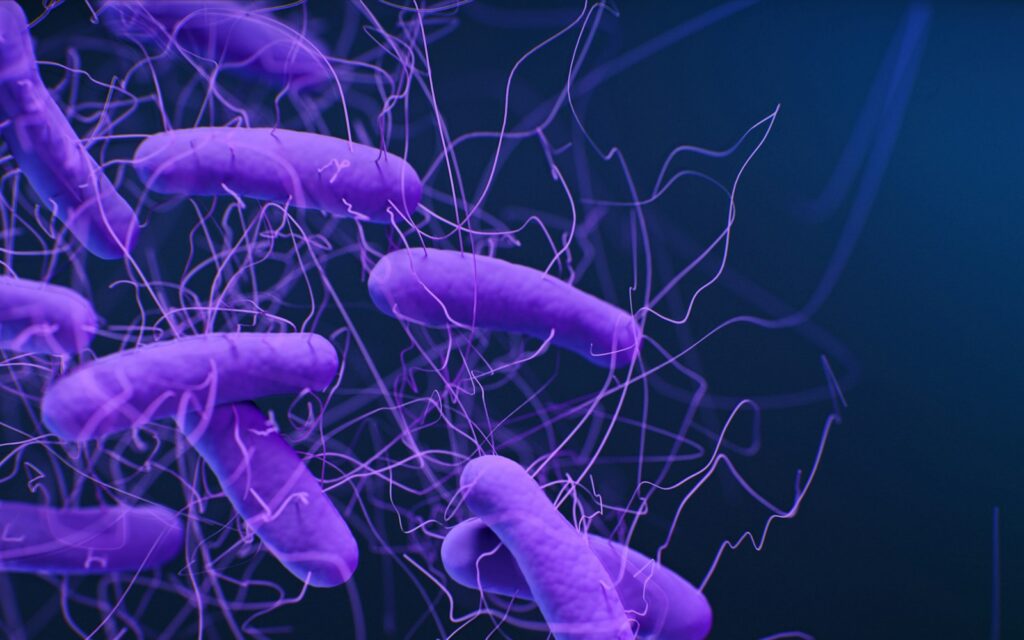
The human body carries roughly as many bacterial cells as it does human ones, a revised estimate from Sender and colleagues in PLOS Biology (2016) that replaced the widely cited but incorrect 10-to-1 figure. Most of those bacteria live in the gut, where they now have two approved drugs to their name for a single condition, recurrent Clostridioides difficile infection: Rebyota (2022) and Vowst (2023). What the microbiome does beyond that is the subject of one of the fastest-moving areas in biomedicine.
The numbers were smaller than the textbook said, but still large
For decades the figure of ten bacterial cells for every one human cell was repeated as a rule of thumb. A 2016 PLOS Biology paper by Ron Sender, Shai Fuchs, and Ron Milo at the Weizmann Institute revisited the calculation and found the ratio was closer to 1.3 to 1: about 38 trillion bacteria against about 30 trillion human cells in a 70-kilogram reference adult. The authors of the revised estimate wrote that their analysis “updates the widely-cited 10:1 ratio, showing that the number of bacteria in the body is actually of the same order as the number of human cells, and their total mass is about 0.2 kg.” The correction did not change the biology; the microbiome is still numerically dominant, just not by an order of magnitude.
The community is more than bacteria. It includes archaea, fungi, and viruses, and it differs sharply from person to person. Two adults sharing similar diets can still have gut communities that overlap in fewer than half of their species. That variability is one of the reasons microbiome claims that hold in aggregate are hard to translate to any individual person.
Short-chain fatty acids are the main output the body uses
When gut bacteria ferment dietary fiber they release short-chain fatty acids (SCFAs), principally butyrate, propionate, and acetate. Butyrate is the preferred fuel for the colonocytes, the cells that line the colon; without it, the barrier weakens. SCFAs also enter circulation and act on receptors in the liver, muscle, and immune cells. They tune inflammatory tone, influence insulin sensitivity, and appear to play a role in appetite signaling. The mechanism is one of the clearest lines the microbiome has to the rest of the body.
Beyond SCFAs, the microbiome synthesizes several B vitamins and vitamin K, metabolizes bile acids in ways that affect fat absorption and glucose control, and produces precursors to neurotransmitters. About 90% of the body’s serotonin is made in the gut, though the fraction that reaches the brain in this form is negligible.
The gut and brain signal each other through several routes
Communication between the gut and the brain runs in both directions, through the vagus nerve, through circulating microbial metabolites, and through immune signaling. In animal models these routes have been used to change behavior: transplanting stool from anxious mice into calm ones has been shown to transfer some of the anxious phenotype. In humans, associations between gut microbial composition and depression, anxiety, and cognitive function are well documented, but causal evidence at meaningful effect sizes is still limited. The direction of causation, and how much of the association is confounded by diet, exercise, and medication use, remains an active question.
The first microbiome drugs are approved for one condition
Recurrent Clostridioides difficile infection, in which the gut community fails to reassemble after antibiotic treatment and a pathogenic strain overtakes it, was the field’s first clinical target because the underlying biology is straightforward. Restore the community, and the pathogen loses its opening.
The FDA approved Rebyota (fecal microbiota, live-jslm) from Ferring in November 2022, a rectally administered product derived from screened donor stool. In its pivotal randomized trial (PUNCH CD3), a single dose reduced recurrence at 8 weeks to 70.6% treatment success, against 57.5% for placebo. The FDA approved Vowst (fecal microbiota spores, live-brpk) from Seres and Nestle Health Science in April 2023, the first oral microbiome drug. Vowst is a capsule of purified bacterial spores rather than whole stool. In its pivotal trial (ECOSPOR III), recurrence at 8 weeks was 12.4% on treatment versus about 40% on placebo (relative risk 0.32; 95% confidence interval 0.18 to 0.58). Both were priority reviewed and represent the first true clinical wins for microbiome-based therapy.
The evidence beyond C. difficile is thinner than the coverage suggests
Outside recurrent infection, microbiome claims run further ahead of the data. Randomized trials have shown that specific dietary patterns change microbial composition. In one landmark study (Wastyk et al., Cell 2021), a high fermented-food diet increased microbiome diversity and reduced inflammatory markers over 10 weeks in healthy adults. Trials of probiotic supplements are mixed and strain-specific: benefits shown for one strain in one condition often fail to replicate for a similar strain or a nearby condition. Fecal microbiota transplantation outside recurrent C. difficile, for inflammatory bowel disease, obesity, or depression, has produced signals but no established treatments.
What the evidence supports doing right now
The most consistent evidence favors dietary strategies over supplements: eating a wide variety of plant foods (a target of about 30 different plants per week is used in research), including some fermented foods (yogurt, kefir, kimchi, sauerkraut), and getting adequate dietary fiber. Antibiotic exposure, especially broad-spectrum, disrupts the community for weeks to months and should be treated as a real cost when the drugs are not clearly indicated. Improving the environment the microbiome lives in through diet is generally more impactful than adding a single strain through a pill.
What the evidence cannot yet answer
n
Most of the strongest microbiome findings are associations from observational studies. Whether specific gut communities cause metabolic, immune, or neuropsychiatric outcomes, or reflect them, is the central open question in the field. Probiotic supplement trials have been mixed and strain-specific: benefits shown for one strain in one condition often fail to replicate for a similar strain or a nearby condition. Fecal microbiota transplantation outside recurrent C. difficile, for inflammatory bowel disease, obesity, autism, or depression, has produced signals but no established treatments. And how much of the diet-microbiome-health relationship runs through the microbes themselves, rather than through the diet directly, is still an active research question that will take controlled feeding trials at a scale that has not yet been done.
n
References
- Sender R, Fuchs S, Milo R. Revised Estimates for the Number of Human and Bacteria Cells in the Body. PLOS Biology, 2016; 14: e1002533. DOI: 10.1371/journal.pbio.1002533
- Cryan JF, O’Riordan KJ, Cowan CSM, et al. The Microbiota-Gut-Brain Axis. Physiological Reviews, 2019; 99: 1877-2013. DOI: 10.1152/physrev.00018.2018
- Wastyk HC, Fragiadakis GK, Perelman D, et al. Gut-microbiota-targeted diets modulate human immune status. Cell, 2021; 184: 4137-4153. DOI: 10.1016/j.cell.2021.06.019
- Feuerstadt P, Louie TJ, Lashner B, et al. SER-109, an Oral Microbiome Therapy for Recurrent Clostridioides difficile Infection. New England Journal of Medicine, 2022; 386: 220-229. DOI: 10.1056/NEJMoa2106516
- US Food and Drug Administration. FDA approves first fecal microbiota product. Press release, November 30, 2022. Available at: fda.gov